History


Early years
By the end of the nineteenth century Grimsby, Cleethorpes, and the surrounding area, had
enjoyed fifty years of economic expansion, based on its excellent port facilities, its national rail
links, and the successful marketing of fish, timber, coal and agricultural produce. During the second
half of the century the population had risen from 9,000 to 75,000, as people came from all over
Britain to look for work. All of them needed houses in which to live, besides other buildings such as
factories, shops, schools, churches, banks and hospitals.
In 1894 a group of like-minded and far-sighted building employers founded the Grimsby Cleethorpes
and District Building Trades Employers’ Association, now known as the Grimsby District Builders’
Association. The time was marked by great opportunities as well as by great difficulties, and the
Association united builders to meet any situation which might face them. It was a time of expanding
production, increasing population, and also a time of great innovations. For the first time private
houses could have the luxury of electric lights and electric cookers. The year saw the erection of
Grimsby’s first council secondary school, and the founding of its first public library. The remaining
open land in New Clee between neighbours Cleethorpes and Grimsby was being built over.
In 1893 the Grimsby Observer had commented on the year’s trade:
“Grimsby has suffered severely during the present year from extraordinary causes of depression, amongst the chief of which may be mentioned the coal strike, the cholera scare, and the great storm of November.”
“In the town of Grimsby itself, as distinguished from the port, the building trade appears to have been the most active of local industries, the extension of the Sidney Sussex College Estate (in the parish of Cleethorpes) and the Weelsby Estate of the Right Honourable Edward Heneage, M.P., having found employment for a large army of bricklayers, masons, joiners and workmen of kindred trades. Large as have been the building operations of 1893 there is every prospect of their being eclipsed during the next year or two by the opening out of Clee Carrs Estate, belonging to Mr Grant Thorold, negotiations for which are just about completed between that gentleman and the Grimsby Corporation, these including provision for large arterial thoroughfares and magnificent open space as a recreation ground for the inhabitants of that district.”
“Its inhabitants have much to congratulate themselves upon and to be thankful for, while the prospects are of the brightest character.”
From the start the Association included members from many local building firms, both in the town
and in the surrounding countryside. Many of the firms were family concerns. Many became well-
known locally, and some of them remain active until the present day.
The Association was also born in a time of national industrial ferment. Workers in many industries
sought to improve their wages and conditions. Trade union membership grew. Trades councils were
established. For the first time a new political party, the Independent Labour Party, gained many
votes. It was in the interests of builders and other employers to associate and seek common
agreement on such matters as wage rates and working practices.
The first President of the Association was Arthur James, a native of London, where his father was a
civil engineer. His father had died when Arthur was still young. Arthur was raised by his widowed
mother, and set out to make his own way in the world. Like so many he was drawn to the booming
Humber, and first appeared in Grimsby about 1891. By 1896 he was working there in partnership
with his older brother Henry as a dock and railway contractor. But soon after helping to found the
Association he died, at the age of 43, and the firm disappeared with him. As so often in business the
line between success and failure proved very thin.
Another leading light of the Association was John Thompson who became President in 1907. He had
come to Grimsby with his father in 1876 to build the borough’s first council school at Holme Hill. In
due course John took on his father’s business and by the time of his death he had overseen the
construction of hotels, churches, ice factories, the Killingholme aerodrome, and housing schemes
in Cleethorpes and Grimsby as well as in many other parts of Lincolnshire. When John died at a
great age in 1948 he had outlived two of his sons and was the last surviving founder member of the
Association. He had been followed in business by his third son, Charles, and during Charles’
time such landmarks as the Grimsby Ice Factory, the Clee Park Hotel, and Harold Street School, were
erected. Charles was President of the Association from 1922. When he died he was described
as “first a builder, but … … also an ardent apostle of friendly co-operation of commercial interests
amongst themselves, and with the governing powers, believing that in that direction lies progress in
the common good.” Close family connections and long years of service are a common theme in the
lives of many Association members.
Wars and recoveries
The Housing and Town Planning Act of 1909 permitted local authorities to draw up town planning
schemes. Progress was limited at first, and further delayed by the outbreak of war in 1914. At its
end the country was faced with a housing shortage, and building activity revived. The first council
house in Grimsby was built in Armstrong Street in 1921, and the development of the garden suburb
of Nunsthorpe followed in 1922. There were also major commercial projects, of which the extension
of the Grimsby Fish Docks was one.
Post-war government legislation was expanded to cover not only estate layouts but also to give
detailed guidance on building design and materials. Members of the Association played a full part in
this work, and the Association itself encouraged co-operation with local authorities and the co-
ordination of work among its members. As Alan Dowling has pointed out in his study of local
development, most of the town’s fabric was laid out by local surveyors, architects and builders, and
their workforces.
Throughout the inter-war period builders continued to make their contribution to the development
of the area, taking on a wide variety of work including new streets and sewers, road improvements,
and recreation grounds, as well as houses and public buildings. All over England large landowners
were reducing their dependence on agriculture by selling off their estates for house building, and
Lincolnshire was no exception. Some estates were bought by private developers, and some were
bought by local authorities. There was both a need to clear and replace slum housing, and to provide
for an increasing population. By the end of the 1930s private builders had constructed 5,500 new
houses in Cleethorpes and Grimsby.
The Second World War began in 1939. During its course many houses, factories and dock works
were damaged by enemy bombing raids. Just as in 1918 the war was followed by a housing shortage.
Part of the response was to provide “prefabs”. Another was to press on with a renewed programme
of council housing. The thousandth council house in Grimsby was completed in 1948. In the fifteen
years after the Second World War local authorities took a more active role but even so private
builders financed about one-third of new housing.
The independent Association in recent years
Members in Grimsby had played a full part in the activities of the National Federation of Building
Trades Employers. But with changes in the Federation’s organisation a large majority of the seventy
members felt that they should try to go it alone. So In 1968 the Association took the momentous
step of disaffiliating from the Yorkshire region. Time has justified the decision. Although it lost its
regional and national participation, the Association gained the independence to put submissions
direct to central and local government, and to play its full part in consultations with local authorities
on the subject of housing structure plans and the availability of land for housing.
The Association was ready for new challenges in the 1970s. The decade saw a great increase in the
amount of improvement grant work, and co-operation on a range of other issues with local
authorities. Besides new building, there was more refurbishment of existing property.
Among other issues, for the first time, the problem of flood risk became a general concern.
In 1975 the Health and Safety Act brought new responsibilities of care to all employers, and the
Association’s members had to apply them in the building industry and protect their workers. There
were new technical demands which had to be integrated into systems and costs: in 1980, for
example, the Association discussed the safety of new flue designs, and in the following year
investigated the merits of kiln-dried timber against those of timber seasoned in the open-air.
The Association’s members were keenly aware of the state of the country’s economy. The level of
construction work is often taken as an indicator of the health of the economy, but to some in the
industry it seems rather that building is the first sector to suffer, and the last to recover! The
proportion of new build in the housing market declined in the mid-1980s and members faced and
overcame great challenges in trading, as members had done through the cycles of previous years.
By 1982 there were more administrative pressures on time-tables and costs: the Association made
representations against the slow response to requests for Land Registry searches, and the
Association sought the views and advice of building societies concerning the levels of house
valuations.
Government policy continued to be a vital factor in planning. In 1981 the Association encouraged its
members to participate in the government’s Youth Opportunities Scheme . After 1990 the
Association’s members had to adapt to an even wider world, as the European
Regional Development Fund came into being.
Although the membership of the Association had begun to fall in the 1980s and early 1990s it had
risen to fifty-five by the time of the centenary in 1994. At the 100th A.G.M. the Association
President was D.F.A.Would, and the Vice-President was G.F.Dyson. It had been a difficult trading
year for many members, and small and medium sized firms in particular faced an uncertain future.
Against this background the President stated that he “hoped to carry on the tradition of the
Association but to bring it more into line with what was required of it in the future.” And in the
company of twenty-one Past Presidents who attended the Centenary Dinner, he commented, “There
is a bond between builders that stretches back 100 years. I would like to think that same bond will
unite us for another 100 years”.
The Association has long played a part in encouraging training, and for many years has sponsored a
series of awards to local higher education students and employees of local firms. Representatives of
the Association sit on many local employment and advisory committee.
Two private limited companies with share capital assist the Association’s members. Land Developers
(Lincs) Limited was incorporated in 1960, and Humberside Land Developers Limited was
incorporated in 1970. They acquire land on members’ behalf, develop roads and joint services, and
then distribute the developed land to members. This has enabled firms of different sizes to jointly
complete many large residential developments.
Since 1894 the Grimsby Builders’ Association has fostered high standards of work in the area,
provided training and an exchange of best practice to its members, and sought to co-operate with
industry bodies and government initiatives, while always remaining constructive in its comments. In
so doing it unites the interests of builders, trades-people, public authorities, buyers and sellers.
Author: John Wilson (Humber Research Services), 2013.
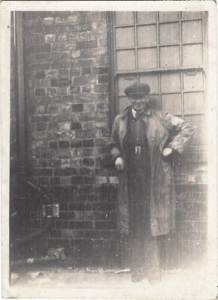
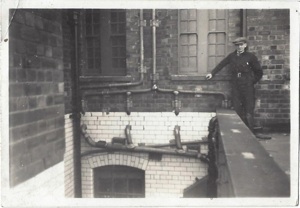
Tom Dixon.
(Simon Dixon’s grandfather showing his lead skills.)

